Photographs

Breweries are booming but DWI busts are down

By Felecia Pohl and Autumn Scott


The number of breweries in New Mexico has more than doubled over the past few years, yet, perhaps surprisingly, there was a 25% decrease in drunk driving arrests between 2012 and 2016.

In 2012 there were 13,810 DWI arrests while in 2016 there were 10,344 and according to Mothers Against Drunk Driving, New Mexico was ranked 25th in the nation for drunk driving in 2016.

New Mexico State Police Public Relations Coordinator Lieutenant Elizabeth Armijo said, “We continue to actively target drunk driving around the state. Every month State Police districts statewide conduct operations specifically targeting drunk driving, including DWI Checkpoints and saturation patrols. It is a priority of the New Mexico State Police to keep our roadways safe.”

People enjoyed their time at Marble Brewery downtown location on Saturday April 21 2018 to celebrating the brewery’s 10th year in business. Photo: Autumn Scott

In the state’s largest city, the Albuquerque Police Department conducts training to combat drunk driving.

APD Patrolman Anthony Hans said, “we have DWI enforcement units whose whole job is DWI investigations and DWI enforcement. I think that’s a major contribution to [DWI’s going down.]”

Hans has three breweries on his beat: Marble downtown, Tractor Brewery, and Rio Bravo Brewery. He works Friday through Monday, and said he doesn’t “typically receive calls as far as disturbance calls or public intoxication calls to those locations.”

Hans said one of the reasons for not receiving as many calls to those breweries is their three beer limit, which decreases the number of extremely intoxicated people at those establishments.

Erica Packer, 28 and server at Desert Valley Brewing Co., said that servers and brewery owners are responsible for making sure their patrons aren’t over served.

“We need to become more responsible and that’s where the brewery owners and the brew community get involved,” she said. “You don’t see competitiveness between the breweries, you see them work together. I think that’s the biggest thing. They look at people when they come in, if they’ve been to other breweries, and how many beers they’ve had there. Servers and the owners, they all communicate. I think it’s us putting more responsibility onto the servers and the hospitality industry.”

Chris Senutovitch, owner of Desert Valley Brewing Co., said servers at breweries are better at keeping track of what their customers have had to drink.

One of the many tubs filled with ice and Marble beer. Many of these were put out for consumption during Marble Brewery’s 10th Anniversary celebration. Saturday April 21 2018. Photo: Autumn Scott

“I think in general they probably do a better job at keeping an eye on it and cutting off their customers than the bar where they’re lining up shot after shot,” he said. “If you sit down for a beer or cocktail and you sip on it slowly you tend less to over do it.”

Senutovitch also attributes the fact that there are fewer drunk people at breweries because breweries aren’t open as late as bars.

“Breweries close at 12:00 a.m.,” he said. “I think where people make a lot of the poor decisions is after midnight until 2:00 a.m. That’s where people cross the line.”

Patrolman Hans said that ride sharing services should receive a lot of credit for getting people home safely.

“The ride sharing programs like Uber and Lyft have helped a lot,” Hans said. “This is giving people more opportunity to do the right thing and get a ride home.”

The Albuquerque Journal reports that a ride about 11 miles long is around 71 dollars in a taxi compared to around 30 dollars with an Uber.

Packer used to drive for Uber and recognises its usefulness when it comes to drunk driving in New Mexico.

“I drove for Uber for a while and that helps out,” she said. “Just having the access to it is better than relying just on taxis cabs. We can make better decisions without having to basically break the bank with cabs. That’s been a huge influence on us so far.”

Senutovitch has noticed that public transportation is growing in New Mexico.

“Three years ago you’d wait and hour and a half for a cab and now it takes two minutes to get an Uber,” he said.

A recent statement made by New Mexico Governor Susana Martinez said DWl related fatalities decreased by 16% from the year 2016-2017. Last year there were 145 alcohol-involved fatalities, which was down from 173 in 2016. In Bernalillo County, DWI fatalities also went down from 52 to 38. The number of alcohol-involved crashes decreased as well from 2,073 to 1,805.

Martinez has been an active proponent of tougher restrictions on drivers under the influence. In 2016, she enacted legislation to increase penalties against drunk drivers. According to her office, her administration has also launched a campaign aimed to stop servers and establishments from over-serving alcohol. Martinez also announced a court monitoring program that placed citizens inside courtrooms in six counties to shed light on how DWI cases are handled.

Originally posted in the New Mexico News Port.

Brewing Industry in New Mexico Still Expanding

By Felecia Pohl and Autumn Scott.


The brewing industry in New Mexico is growing at a rapid pace, with more than 90 craft breweries around the state in 2018, compared to 25 in 2011.

There are many reasons why New Mexico is an appealing place to open a brewery. Among the main reasons are the barrel cap laws, which regulate how much beer a brewpub can make per license. New Mexico’s barrel cap laws are considered lenient, as licensees in New Mexico that retain a restaurant, manufacturer, or small brewers (off-site) license do not have a brewing limit. The only limit is placed on those with a small brewers license where the brewing is done onsite. That limit is 200 thousand barrels per year. However, those small brewers may brew beer offsite with no limits.

Another factor encouraging industry growth is that brewery and distilling licenses are much cheaper than full liquor licenses.

Desert Valley not only brews beer, but distills spirits, and serves cider and wine from other local businesses as well. Photo: Autumn Scott / NM News Port

“If you want to get a full liquor license you’re looking at anywhere from $400 thousand to $1 million dollars,” said Dakota McCarthy, head chef and partner at Desert Valley Brewing Company,. “It costs us $2,500 a year [for a brewing and distilling license]. It’s not just taxes, but the overall expenses are next to nothing compared to getting a full liquor license.”

According to Albuquerque Business First, from 2013 to 2016, liquor sales in New Mexico decreased 32 percent, wine sales decreased 34 percent, and sales from large breweries dropped 7 percent. In contrast, sales of beer from microbreweries in the state increased 124 percent.

Chris Senutovitch, the owner of Desert Valley Brewing Company, said that breweries are becoming a lot more popular.

“People are getting more and more into craft beer,” he said. “Craft beer is taking up a lot more market share on beer sales.”

Desert Valley has a distillery in the restaurant which distills vodka, gin, rum, and whiskey. Photo: Autumn Scott / NM News Port

Residents in Albuquerque have taken notice.

“I’ve been in Albuquerque for nine years, and from what I remember there was a few of them when I first came,” said Adolfo Maes, an Albuquerque resident and frequent brewery patron. “I didn’t even like brewery beer then. I got the taste for it, and now there’s more than I can count.”

But with this growing industry in New Mexico, people have mixed views of the future and the effect that oversaturation of breweries could have on their business.

“As far as I’m concerned, there’s no way we can maintain the amount of breweries that we have in this city just due to our size,” McCarthy said.  “I think eventually it’s going to level out and I think the breweries that are different and do different things and offer more are the ones that are gonna stay.”

Senutovitch shared a more optimistic outlook on the industry.

“I hear people talking about oversaturation,” he said, “but you see a lot of [breweries] doing pretty good.”

Senutovitch said he thinks that national commercial brands are the ones that suffer from oversaturation since now people want to shop locally.

Cristal Chavez, another Albuquerque resident, said there needs to be more breweries in certain areas of the city.

“On the Westside we need more,” she said. “It’s all Nob Hill, Downtown area, and us that live on the Westside, we don’t like to commute that far to go to a brewery, I think we need more.”

With the number of breweries popping up around the city, Desert Valley tries to stay ahead of trends, Senutovitch said.

Desert Valley Brewing Company is one of the newest additions to the Westside area of Albuquerque. Photo: Autumn Scott / NM News Port

“If you’ve noticed, a lot of the breweries are developing into full restaurants and increasing their offerings.” he said. “We just wanted to hit the ground running, so we can be on the front end of that, instead of following what everybody else is doing.”

McCarthy also recognized that Desert Valley needs to do more to stay ahead.

“We’re the only brewery in the state that offers cocktails, cider, beer, and has a full kitchen,” he said. “We’re constantly pushing the envelope with our food, with our cocktails. We separate ourselves pretty far just on those aspects and just kinda going big or going home.”

He also said the culture around drinking is changing as well.

“People aren’t looking to get wasted and go out to the club and drink until they can’t drink anymore,” he said. “It’s more of let’s go and have a good time, have some good food, have a few good beers, and call it a day.”

Maes said he enjoys breweries more than bars.

“In bars these days it’s sagging pants, fights, and I don’t like that younger crowd,” he said. “I prefer a more mellow crowd. And the beer is better.”

According to New Mexico Dark Side Brew Crew’s calculations, there are 20 new breweries scheduled to open in New Mexico in the future.


Originally posted in New Mexico News Port.

Native American Women Are Scared To Speak Out About Their Abuse

By Felecia Pohl and Autumn Scott


The #MeToo movement has given women the platform they need to tell their stories, but some women in the Native American community are still apprehensive to speak out. Studies show Native American women are twice as likely to experience sexual violence in their lifetime compared white women to their white counterparts.

Anthony Tillman, Vice President of NNAHRA encourages women to feel comfortable speaking out against sexual violence in their communities. Photo: Courtesy / NM News Port

Anthony Tillman, Vice President of the National Native American Human Resources Association, said sexual violence is hardly reported by native women because a lot of the violence is committed by close family or important community members.

Based on a 1999 research report conducted by the Bureau of Justice Statistics, Native women are more likely to experience sexual violence with someone they know.

“It happens interfamily,” Tillman said. “It’s their uncles… (or) the pillar of the community that does so much, but has these secrets. You don’t want to be the one to bring that person down. (People think), ‘Nobody is gonna believe me.’ It’s a lot of pressure to come forward.”

According to research conducted by the Bureau of Justice Statistics, 68% of Native women were raped by intimate partners, family members, or acquaintances. The other 32% of rapes were committed by strangers.

Renee Lowden, a Native American woman who works as career tech training manager at Albuquerque Job Corps, said the fear of speaking out runs deep.

“I think sometimes what happens on the reservation is women think, ‘If I report this sexual abuse, is my family gonna back me and if they don’t back me, where am I going?’,” Lowden said.

According to a 2016 research report conducted by the National Institute of Justice and written by Andre B. Rosay, Ph.D., more than 4 in 5 American Indian and Alaska Native women have experienced violence in their lifetime, that is 84%.. And 56% percent said they experienced sexual violence.

Rachael Lorenzo, Communications and Outreach Coordinator for Native Community Development Associates — a woman-owned company that promotes Native communities  aids survivors of sexual violence, but said she can only help if the women decide to speak up.

“NCDA have such an important role to play from the time a call is made to report an assault, if a call is even made, because not all assaults are reported, especially for native people,” she said. “A police officer visits the home, and usually a social worker will accompany the officer.”

Lorenzo said the police officers and social workers strive to create an environment for survivors in which they feel safe enough to report these incidents. Despite the efforts, some victims are still hesitant to ask for help.

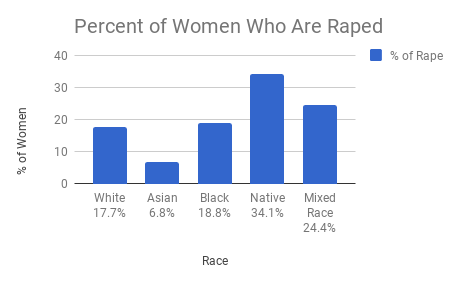
Based on data found in a 2016 research report conducted by the National Institute of Justice and written by Andre B. Rosay, Ph.D., “Sexual Violence vs. Race” shows that Native women are two times more likely to experience sexual assault than white women.

Tillman said women are also afraid to speak up because if they do, they can be ostracized from their community. This can lead to being fired as well as a tarnished reputation, making it hard to maintain a household and find a new job.

“Women learn to keep their mouth quiet about it,” Tillman said.

But, Tillman said, communities need to encourage women to speak up and not fear the retaliation.

“I think you always have to make an example of somebody in order to make the movement strong,” he said. “You have to find someone who is willing to accept the consequences of coming forward.”

Tillman said the encouragement and confidence to speak up starts in the home. Before children are introduced to the opinions of the community, parents should be instilling a sense of morality in their kids. He said just because the community has thought one way for so long, doesn’t mean it’s right. Wrong is wrong.

Tillman said parents need to break the cycle, especially, “if parents have been part of the abuse and they haven’t said anything, the kids see that and they feel like they better not say anything.”

Lowden said sexual violence is not talked about or reported because people have learned to keep it hidden because that’s the norm.

“Another thing that happens is we’re dealing with the daughters of the mother,” Lowden said. “Because we’re dealing with the daughters of the mothers who have been sexually assaulted or sexually abused, it could be that they didn’t have the resources themselves, and so they don’t know how to handle their daughters and their issues and because of that they don’t know how to refer them.”

“Managers and supervisors came to me,” he said. “They asked, ‘hey, what can we do? Are people trained? Do our people even know what it looks like? Have we been properly equipped to even identify what sexual harassment or sexual misconduct is?’”

Based on data found in a 2000 research report conducted by The National Institute of Justice, this graph shows that Native women are raped more than any other race.

But Tillman said tribes have begun to better equip themselves with the tools they need to handle these kinds of situations.

Tillman said NNAHRA holds summits with different tribal nations across the country to discuss and address the problems natives are facing. Tillman said he hopes that with proper training, tribes will learn to better deal with sexual harassment and violence, which in turn will lead to people speaking up when there’s a problem.

But, Tillman said, the policies don’t matter if they’re not met with support.

“We want our women to understand they have a safe place,” he said.


Originally published in New Mexico News Port.

Native Women Leaders Express #Me-Too Concerns

By Felecia Pohl and Autumn Scott


The Navajo Nation recently took measures to address sexual harassment at the upper levels of the nation said Delena Otherbull the executive director of the Coalition to Stop Violence Against Native Women (CSVANW) based in Albuquerque.

When the #Me-Too movement gained traction last fall on mainstream media, it called attention to women who were facing sexual violence, but some local Native American women leaders said their communities have been fighting this battle for generations and need more light on their situation.

“Navajo Nation Council Woman Amber Krotty came forward last year and basically brought to light the sexual harassment that was happening even at the leadership level,” Otherbull said. “Since then they’ve mandated that all tribal employees have sexual harassment training.”

Otherbull said  Native Americans are also addressing policies around workplace harassment. “So rather than creating laws, they’re focusing on employee policies in determining what these policies look like within their own communities and really looking at how they can be enforced,” Otherbull said.

Deleana Otherbull, executive director at CSVANW, said conversations about sexual violence against Native American women have been going on long before ‘#Me-Too’ started to trend. Courtesy photo: CSVANW website

Renee Lowden, a Native American woman who works as a career tech training manager at Albuquerque Job Corp, said until women can take on leadership roles in the native community, there will be no change.

Otherbull said she welcomes the national attention the #MeToo movement is putting on the issue of sexual harassment of women, but she said the Native community and other minority groups are still being left out of the conversation.

“I think there needs to be more focused efforts to really bring everybody into the conversation,” she said. “I’m not just advocating for our Native women or the LGBTQ, but making sure our Asian communities are being represented, and our Spanish speaking communities are too. This affects everyone, it’s not just celebrity or high profile cases. This is really affecting those who are marginalized.”

Otherbull said, there are far more cases of sexual abuse away from the celebrity spotlight.

“These women are making minimum wage and are being sexually harassed by their employers,” she said. “These are people who work in our industries and farms. They’re being sexually harassed and then threatened with losing their job if they speak up. It permeates every sector of our communities.”

Otherbull said that Native women are disproportionately targeted, and because there isn’t a national conversation about Native women, there are efforts made by the Native American community to stop sexual violence.

Rachael Lorenzo, Communications and Outreach Coordinator, uses different ways to connect with her community in order to educate them on issues in the Native American community. Courtesy Photo

Rachael Lorenzo, Communications and Outreach Coordinator, uses different ways to connect with her community in order to educate them on issues in the Native American community. Courtesy Photo

Rachael Lorenzo, Communications and Outreach Coordinator for Native Community Development Associates — a woman-owned company that promotes Native communities  argues for greater empowerment of these communities at the local level.

“Community organization and activism is so important for these issues that impact Native people,” Lorenzo said, “because there is a real gap in the bureaucracy and in the government at any level to address those real needs.”

Otherbull said that one of the good things to come out of the #Me-Too movement was it encouraged victims to speak out against their abusers, but those who choose not to speak shouldn’t be forgotten either.

“We also have to remember that silence is strength as well,” she said. “So for everyone who didn’t come forward, they are no less strong or their voices are no less valid.”


Originally published in New Mexico News Port.

Students at UNM Talk About The Stress That Comes From Midterms and Finals

Written with Justine Lopez and Jaden Torres.


With the end of the semester quickly approaching at the University of New Mexico, students are reflecting on how they dealt with the stress of midterms, as well as planning for finals.

According to a 2017 study from the Indian Journal of Health and Wellbeing, “a cross institutional study found stress the top of health problem which worried students most, followed by body image, AIDS, physical fitness, and cancer.”

Planning For Finals

Student are dealing with the stress that comes from coursework in different ways.

“I always say I’m gonna start studying earlier, but I never do,” said Rocky Cordova, a political science and economics major. “I’m gonna fall back to the staying up all night and coffee.”

Madelyn Lucas, a biological chemistry major, said for finals she plans on spending more time on her schoolwork rather than her extracurricular activities. Lucas also said she wanted to cut back on caffeine use and try to eat healthier as she goes into finals.

library-1400313_1920
Students studying in a library. No copyright image.

Gethen Reilly, a liberal arts major, said he plans to spend more time at home during finals.

“I’m definitely not going to go out as much,” he said. “I’m just gonna lock myself in my room and put my nose to the grindstone and see what comes out of it.”

He also said making a game plan of the upcoming week helps him stay focused.

“I’m just creating a concise schedule for myself every week where I force myself to sit down and I’m like, ‘I have to do this amount of work this time and then after that I can relax,’” he said. “It’s been working pretty well recently. It’s just finding the time and balancing between work and pleasure.”

Taking Care of Yourself

Reilly also said self care is important to make sure students don’t get too stressed.

“Take personal time,” he said. “Don’t try and do it all at once. It’s very much a balance that you have to achieve because if you just try and do everything all at once you’re going to end up crying and that’s not fun. So, for sure take time for yourself, take breaks, treat yourself at the end when you’re done. Other than that, just study hard.”

The Indian Journal of Health and Wellbeing said counseling centers should be available at all college campuses so students can have a place to talk to a professional if they need help dealing with stress.

Students at UNM can go to the Student Health and Counseling building if they have concerns, health problems, or are in need of advice.

It also said, “there should be regular workshops for students on stress management, time management, and assertive training and communication skills.”

Advice For Fellow Students

Lucas also had advice for fellow students who are dealing with stress.

“Anything that you’re given is completely possible,” Lucas said. “There are people all around you if you just say hi to someone and see what they’re studying. They know someone who is studying what you’re studying so if you need a study buddy it’s not that hard.”

Video Story: written, recorded, and edited by Felecia Pohl, Justine Lopez, and Jaden Torres.

Thousands of Students Attended Red Rally at Johnson Field at UNM

More than 3,000 students attended Red Rally, an annual event to kick off the University of New Mexico vs. New Mexico State University football game on Thursday.

Ranked No. 55 in Sports Illustrated’s “102 Things You Have To Do Before You Graduate,” Red Rally started in 2005, when students built an Aggie out of chicken wire and burned it to the ground on Johnson Field. Ever since then, students have continued the tradition of burning an effigy of UNM’s rival mascot, NMSU’s “Pistol Pete.”

Setting Up

“You’d be surprised how much goes into it,” Kaylie Huizenga, executive director of Lobo Spirit told the Associated Students of the University of New Mexico Podcast.

The Aggie was made with feet and feet worth of chicken wire, lots of piping, and  also had over 10,000 napkins and 5,000 newspaper pages.

The Aggie also had over 10,000 napkins and 5,000 newspaper pages.

The weeks leading up to Red Rally had events hosted at Sigma Chi Fraternity where students got involved in building the 25-foot effigy. Once Pistol Pete was ready to make an appearance, Huizenga said it took teamwork to get him from Sigma Chi to Johnson Field, where students, along with the help of the Physical Plant Department of UNM set Pistol Pete on top of the bonfire.

RedRally1
Students watched as the 25-foot Aggie effigy burned to the ground. Felecia Pohl/UNM

Along with PPD, the Albuquerque Fire Department was there to make sure the flames did not get too big and cause problems.

The rally was organized and hosted by ASUNM, and the UNM marching band kicked off the event at 8:00 p.m., followed by the Lobo cheerleaders, the football team, and a DJ, who played through the burning.

This year, UNM students decided on the song “Light It Up” by Major Lazer to play when Pistol Pete was lit on fire.

Student Reactions

“I had no expectations of the event,” said Kayla Ortiz, a junior at UNM.  “I just knew they burned the Aggie. I didn’t know they did anything else with it.”

For some students, attending all school events is a must, but for others, not so much.

“This was my first time attending,” Ortiz said. “I haven’t gone in the two years I’ve been in college and I actually kind of regret not going because tonight was really fun. I only have one more chance to go to so I really want to go to the next.”

Ortiz also said she wants to go to other school functions since she only has two years before graduation.

While some students stood around the effigy and watched it burn, others were dancing by the stage where the DJ played.

RedRally3
It only took about an hour for Pistol Pete to burn to the ground. Students danced to a DJ while the effigy burned. Felecia Pohl/UNM

“I was pretty surprised by the amount of energy there was and how amped everyone got about the rally,” said Lucas Sanchez, a junior at UNM. “I expected it to be more of a social type thing, but there was a lot of energy about a football team that has never been great.”

A Sense of Community

“The best way I can describe what Red Rally is like is when you and your friends get together before a concert for an artist you really love,” Sanchez said. “You all kind of amp each other up about it, even though no one else in the world but your group would care.”

Once AFD put the Aggie embers out at 9:00 p.m., the DJ announced the rally was over. Students were disappointed they were being ushered off Johnson Field, and Ortiz said she thought the rally was going to last longer, at least until 11 p.m.

RedRally2
One AFD announced the rally was over, students were left disappointed it didn’t last longer. Felecia Pohl/UNM

“I showed up after it ended,” said Celina Baca, a senior at UNM. “I thought I would be on time but by the time I showed up everyone was leaving, the DJ was gone, and the Aggie was burned. There were still a good number of people there but I was so sad I wasn’t there for the main parts.”

Property Crime In Coors and Bluewater Area Is Rising

Written with Sarah East and Autumn King


Residents who live in the Coors Boulevard. and Bluewater Road area of Albuquerque, New Mexico have double the chance of becoming a victim of property crime
than people in other parts of the city.

According to Neighborhood Scout, an online real estate database that collects information on crime and other data in an area, the Coors and Bluewater area, ranging from 98th Street. to Coors Boulevard and from Central Avenue to Interstate 40, is one of the most dangerous areas in Albuquerque.

One in 7 people in the area have a chance of becoming victims of property crime, as opposed to all of Albuquerque, where 1 in 16 people have a chance.

IMG_1452
The intersection of Coors and Bluewater in Southwest Albuquerque has a lot of crime. Residents in the area have a 1 in 7 chance of becoming a victim of property crime, according to Neighborhood Scout. Felecia Pohl/UNM

Neighborhood Scout uses a scale of 0 to 100 to rank crime in the nation, 100 being the safest. Albuquerque ranked No. 2 on the crime index, while the Coors and Bluewater area ranked zero. That means the neighborhood is in the category of the least safe. Santa Fe ranked No. 10 while Roswell ranked No. 4.

According to Neighborhood Scout, the national median for property crime is about 26 crimes per 1,000 residents. In Albuquerque, it is about 62 crimes per 1,000 residents. In the Coors and Bluewater area, it is more than doubled at around 139 crimes per 1,000 residents.

Police Response

Albuquerque Police Department officer Jason Fitzpatrick from APD’s Southwest Area Command acknowledged there is a problem in the area.

IMG_1460
The Shawn McWethy Memorial Westside Area Command is the police substation in charge of the Coors and Bluewater area. Officers try to stay in touch with victims of property crime. Felecia Pohl/UNM

“Those neighborhoods have a lot of residential burglaries,” Fitzpatrick said.

According to Fitzpatrick, one of the main reasons for the high property crime rate is drugs.

“These people are paying for their drugs,” Fitzpatrick said. “A lot of the time, they don’t have jobs. So the easiest thing for them to do is go break into a house, break into a car, take someone’s stuff, go down to the nearest pawn shop and try to sell it.”

FItzpatrick said there are measures that can be taken to help keep one’s property safe.

He said to always keep doors and windows locked. Alarm systems are helpful to alert police when a break-in has occurred. Security cameras are also a good way to get evidence in order to catch the thief. Without video evidence, police have to use fingerprints in order to figure out who committed the crime.

“If someone kicks in your door, takes all of your stuff, it’s going to be a lot harder to catch them if there’s no video,” Fitzpatrick said.

Resident Concerns

Residents living in the Coors and Bluewater area do not think cameras do much to stop criminals from committing crimes, including Reg and Darlene Tyler,  who have been victims of property crime multiple times in the past.

“We have cameras that see 180 degrees around our house,” Reg Tyler said. “But criminals know the response rate for property crime and nonviolent crime is slow. Our son works as a 911 dispatcher, he can tell you. If it’s not a priority call, you’re put on hold. Even priorities calls are on hold. Your best bet is to try and defend yourself.”

“I feel that the criminals are more afraid of a big dog in your home than a camera that’s watching them,” Darlene Tyler said.

She also said it is important to build relationships with neighbors.

“If somebody came with a truck and took all of our furniture out, our neighbors would have no clue if we’re moving or not,” she said. “I think it’s important to know your community and your neighbors, exchange phone numbers. But a lot of times people don’t really know their neighbors or get the chance to get to know their neighbors.”

Fitzpatrick said officers try to keep in touch with residents who have been victims of property crime multiple times.

“We make contact with them,” he said. “We will go and knock on the door and ask if everything is good. We also set up tactical plans. We’ll have a brief at the beginning of shift, we’ll go over the problem areas. On slow days when we aren’t taking call to call to call, we will set up in a specific neighborhood or a specific house that has been a problem for us and we will kind of sit on it and watch it.”

Clarissa Montoya, another resident of the Coors and Bluewater area, has lived her house since she was in middle school. She became a victim of property crime last year.

Her house was burglarized and her truck was stolen.

“The time was midday, around three,” Montoya said. “I left to go get lunch and came back and my house was broken into.”

She thinks the thieves must have been watching her as she left her home.

They took items including the truck in the driveway, the surround sound system in the living room, and the mail that was left on the counter.

IMG_1456
The Bluewater and Coors intersection has a higher rate of property crime than the rest of the city. Some choose to install video cameras while others bring their valuables with them wherever they go. Felecia Pohl/UNM

“I was so scared,” Montoya said. “I immediately called the cops, and they did a search for fingerprints.”

Montoya is much more cautious after that incident.

“I take any belongings I really need that have value with me everyday,” she said. “I make sure I always lock the door and check my surroundings when I leave and when I come home.”  

Advice

Fitzpatrick said times have changed for the neighborhood.

“There used to be a time where you could leave your doors and stuff unlocked and you knew everyone in the neighborhood,” he said. “But now I feel like it’s a lot more dangerous especially on that side of town.”

Reg Tyler had advice for anybody who is worried they might become victims of property crime.

“Make your house as uninviting as humanly possible to burglars,” he said. “Whether that’s wrought iron on your windows, beware of dog, cameras, signs in your yard, cars with alarms blinking, clubs on your car, keep all your valuable items out of your car. From paperwork that has your name on it with any type of private information to stereos. Little stuff, too. Anything they can sell for five bucks, two bucks, three bucks, they’re stealing.”

Audio story: written by Sarah East and Autumn King. Recorded and edited by Sarah East.